

About a year ago, I posted my first article on Substack. My only goal was to understand how artificial intelligence would disrupt and transform healthcare.
I had one subscriber, my amazing wife. Though that didn’t matter to me; I wrote for myself because I didn’t know if anyone else would care about the topic.
Much has changed since then:
One hundred and forty-three people are now along with me for the ride. Thank you all so very much for your readership, thoughtful comments, and support!
My writing and research strategies have developed significantly.
I have totally different goals for my newsletter than I did at the start.
Exploring the evolution of my goals is the topic of today’s article. Read on to see why my own irrelevance is the ultimate outcome.
What did I believe a year ago?
My first article contains the boldest claim I’ll probably ever make about AI:
I don’t think we as a society are ready for it. At all.
That was not in reference to healthcare, by the way. I had said that society was not ready for artificial intelligence in general.
I included myself there as well. As a healthcare provider, I was uncertain about how it would affect my work or my patients. The newsletter would serve as a “time capsule” of the things I learned after writing about different topics. My understanding was that people outside of healthcare would only start paying attention once a hospital got sued for AI use that harmed a patient.
How my views on healthcare AI changed
One important realization on April 8, 2026 completely reshaped how I think about healthcare AI governance:
Whether or not society is “ready” for the ramifications of AI is almost totally irrelevant.
The incentive structures driving healthcare AI deployment could not care less what people like me think about whether the technology is ready. They’re building and deploying it, right now.
If I wanted the conversations to include patient safety, I needed to build and deploy my own frameworks just as fast.
The Utah AI prescribing article that changed this newsletter
I saw an article that said something along the along the lines of “AI is writing Prozac prescriptions for people in Utah, and that’s a bad thing for us all.”
Huh?
That sentence completely disoriented me. I simply had to figure out if that person was misleading me or we had an insane situation on our hands.
I’m not going to do another deep dive on that--you can read the article if you want to learn more--but I want to talk about how writing that article changed my newsletter’s trajectory.
What is a “counter-melody” in healthcare AI coverage?
The public reaction to a controversial healthcare AI implementation is often emotionally right but informationally incomplete. In other words, people feel the correct thing, though they might be missing an important part of the story.
And the missing piece is usually the thing that decides whether their anger lands on the right target or the wrong one.
In the Utah article, I shared a couple of things that complemented the story without trying to change people’s reactions:
The AI could only renew previously-existing prescriptions, not write brand-new ones.
A licensed physician would need to review the first 250 prescriptions, and the pilot would only move forward if the agreement rate was high enough.
Per the company, the AI “will immediately escalate the patient to a human clinician if it detects suicidality, severe adverse effects, indications of mania, pregnancy, or if the patient simply requests a human review.”
But most importantly: The state of Utah has a critical mental health care provider shortage. Half a million Utahns have inadequate access to behavioral healthcare, and 99 percent of the state is classified as a “mental health professional shortage area.”
All of that doesn’t change the fact that if not tightly controlled, AI prescription renewal can cause serious patient harm. But, perhaps, it may change your mind about whether it’s a valid option to consider while the state addresses its provider shortage.
Once this shift happens, the questions become more productive. Are the servers HIPAA compliant? Why was a large language model (LLM) chosen over a structured form that patients could fill out? Who holds clinical liability if an AI-facilitated renewal leads to patient harm?
Those are the questions our community formulated after I posted the article. So I asked them to the company doing the pilot, who to their credit, engaged substantively with many of our concerns.
I didn’t invent the concept of doing research to complement an emotionally charged story. My inspiration came from Derek Sivers, who calls it “singing the counter melody” in his book Hell Yeah or No. In music, a counter-melody runs underneath the main melody, against it, and the two together make harmony.
My writing is, as Sivers describes it, “a counterpoint meant to complement the popular point.” I will never try to convince you not to be worried about how AI might alter healthcare (as a patient or a provider) for the worse. I will try very hard to have you ask the right questions and send them to the right places.
The reporting loop I now use
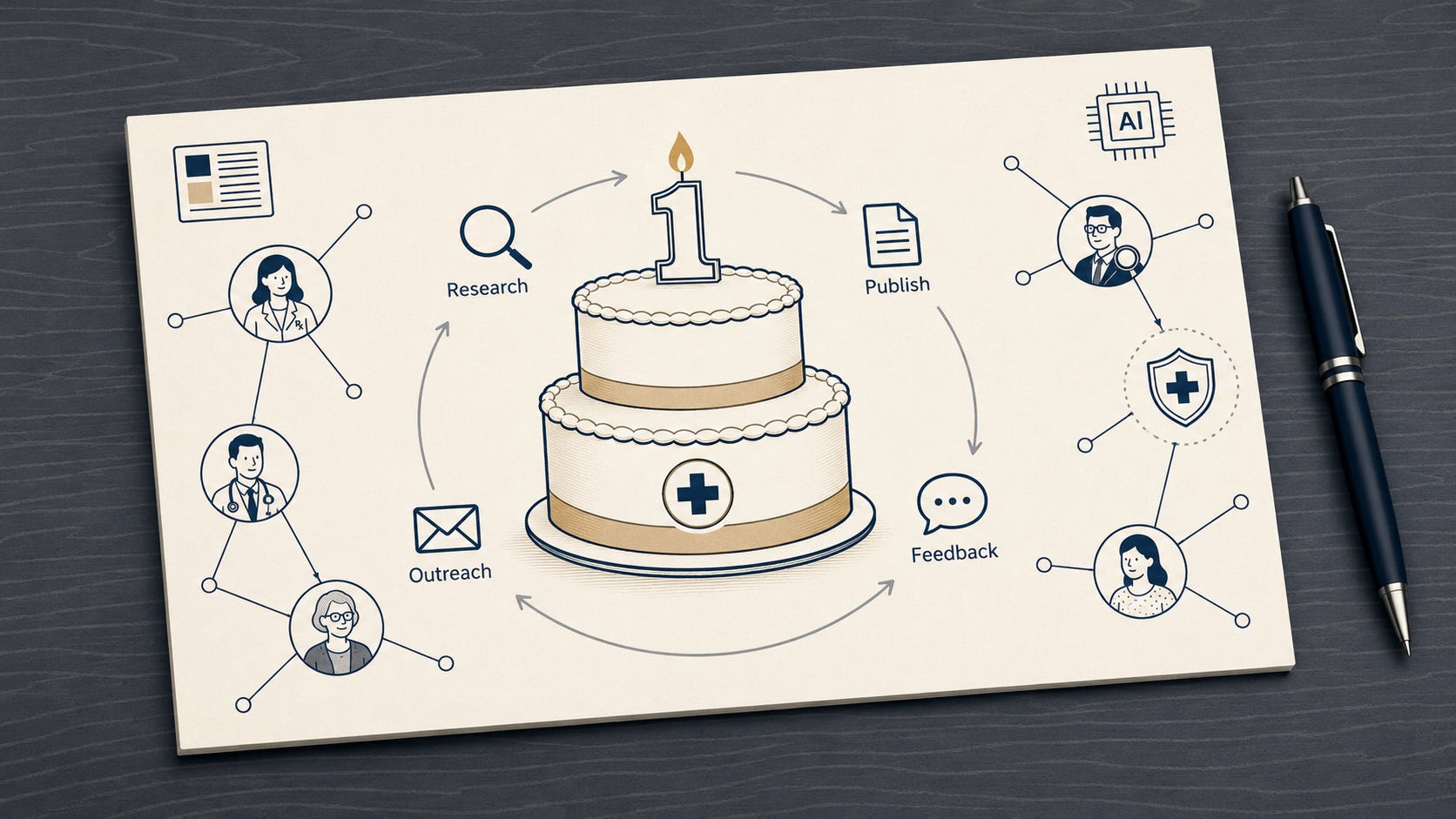
I now had a repeatable framework for covering reactionary discussion about healthcare AI:
I learn more about the root causes behind why AI is being considered in the first place.
The article containing the counter-melody gets published. I ask my readers to share their potential concerns with me.
I take our collective questions and share them with the relevant party. This is both to gain clarity on what’s happening and give the entities I’m discussing a chance to share their perspective if they choose to.
Whether I get a response or don’t, the follow-up article comes next.
Why one healthcare AI newsletter is not enough
The journalism loop I just described is informative but very time-consuming. Writing is not my full-time job. I’m a hospital pharmacist who has very limited time to do investigative research and write about what I find.
I can research Utah’s situation, because it’s just one state. But now Iowa, Idaho, and Montana are now all deliberating on autonomous clinical AI in some shape.
You can see that the effort to research, write, collect feedback, and perform outreach scales exponentially as more states enter the mix. I’ll continue to try my best. What the space really needs, though, is more people doing this work.
How Philly’s AI pharmacist becomes obsolete
I’m proud of what I’ve accomplished with my little newsletter in the past year. I’ve developed a framework that helps complete people’s understanding on controversial topics in the healthcare AI space. Not only that, I encourage others to ask thoughtful questions whose answers truly affect how patients will stay safe.
My sincere hope is that in June 2027, I will be only a single node of a much larger network of healthcare professionals doing similar work. I cannot cover every state’s evolving AI landscape by myself, but maybe several dozen people collectively could.
The long story short
I asked myself, “how do I maximize my efforts of keeping patients safe with AI in healthcare?” The answer is to build frameworks that others can use to amplify the message.
It makes my work less significant, but that’s the whole point.
Read how I use AI in my writing here: AI Use Policy
Read how I use analytics to improve my newsletter here: Privacy & Analytics
Hi Ryan, This is such a good post, and I really love how you reflected on where you started. I also love that you mentioned how, most of the time, when people see AI in healthcare, it doesn't matter if the AI is even doing something good. I think people react emotionally because it is a change to something we are very emotionally attached to: our health. I agree with you that we need to look under the hood to see what the root cause is behind why the AI is being considered in the first place, and whether it could instead make things better for us in healthcare. I fully love that and am definitely excited to see where your newsletter goes in year two.