

Healthcare AI companies operate within an extremely complex communications environment.
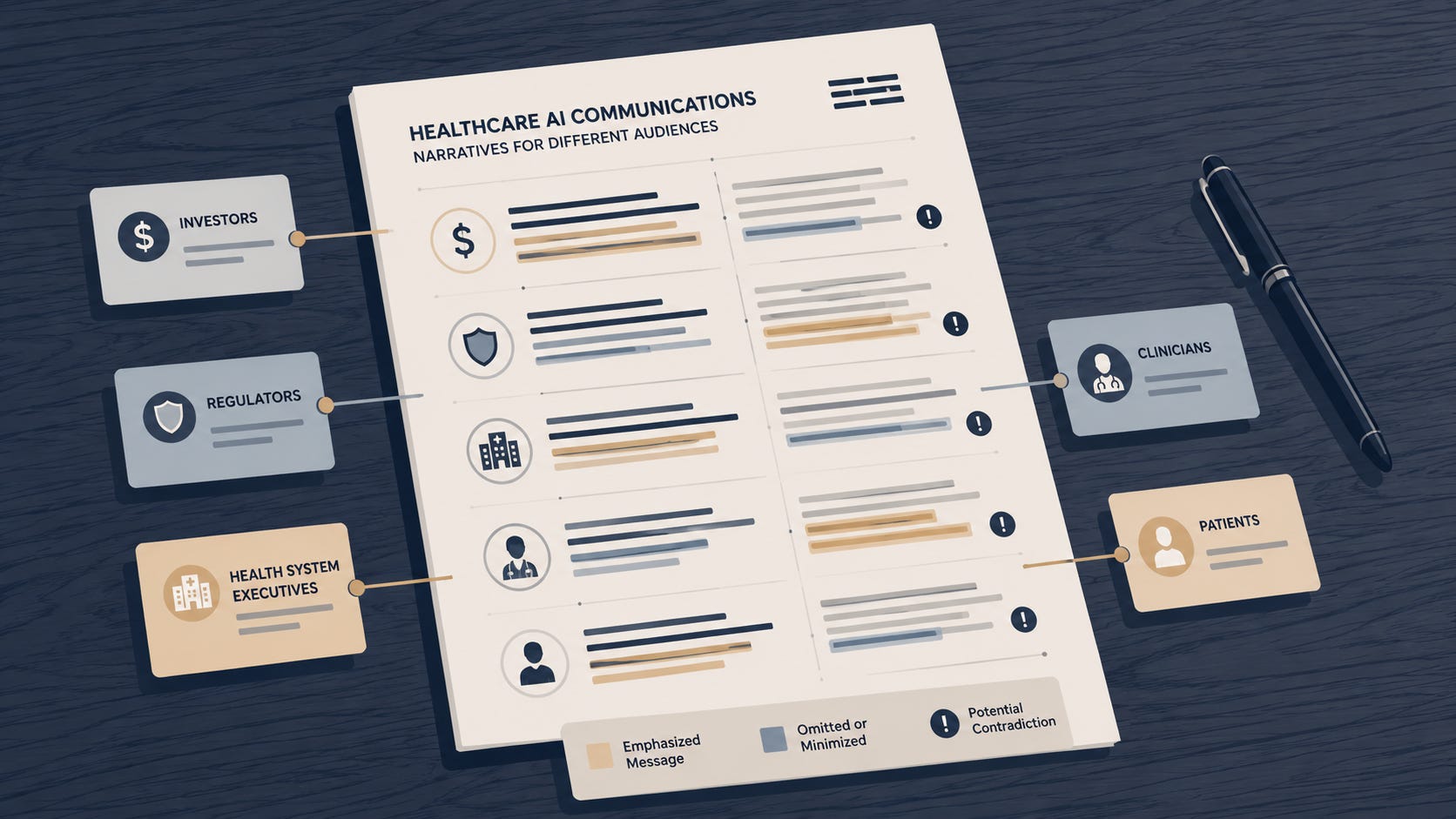
Within a single quarter, a company may need to persuade investors that its market is enormous, and at the same time tell regulators its scope is narrow. They might tell health system executives that the product will transform hospital workflows while trying to convince clinicians that they will retain their autonomy in clinical practice.
Each of these audiences expects a different kind of communication and evaluates the company on different criteria. Because of this, the company must calibrate its wording of concepts differently for every group it communicates with.
This is not, by itself, a problem. Different audiences need different things. For example:
A regulator needs precision about what the product is claiming to do.
An investor wants to see that the product can scale.
A patient needs to know whether the product can help with their health goals.
The question I’ll be exploring in this article is what happens when the language a company uses with two different groups might contradict each other.
When contradictions appear in the register of healthcare AI companies, they are often not random. Some of them are unavoidable given how many groups the company has to communicate with, and some are genuine discrepancies that warrant further attention.
This article is intended to be a general framework that you can apply to any healthcare AI company you choose. It is not written about any company in particular and that’s on purpose.
Key takeaway: Reading only one of the company’s narratives will not give you the full picture. Comparing all the narratives next to each other is the only way to understand what’s happening.
Defining the 13 narratives
Each narrative below is presented in a consistent labeled format:
Where the narrative appears.
Who the audience is.
What the audience expects.
What the company is trying to persuade the audience of.
How the narrative is constructed.
What legitimate purpose the narrative serves.
The structural cost when comparing every narrative together (in other words, where potential discrepancies in the narrative may occur).
After I lay out all the narratives, I will describe how to reconcile all the narratives for different groups such as patients, clinicians, and healthcare executives.
#1: The Capital Narrative
Appears in: Pitch decks, investor updates, board materials, fundraising press releases, and the public pages where investors describe the companies they fund.
Audience: Current investors, prospective investors, and the financial press covering the sector.
Expectations: Ambition calibrated to the size of the opportunity the company is asking them to fund.
Persuasion target: That the company is worth funding at the proposed valuation, that the market opportunity is large enough to justify the projected returns, and that the current team and technology are positioned to capture it.
Narrative strategy: The company’s market is described at the largest defensible scale. Growth rates are presented as accelerating. The technology is described as a category-defining advance over existing alternatives. Competitors are framed as incumbents whose business models are about to be disrupted. Future capabilities are presented alongside current capabilities with minimal distinction between them. Unit economics are described in terms of projected efficiency rather than current performance.
Purpose: Investors evaluate companies on potential rather than present-state performance. The pitch register exists to communicate that potential efficiently.
Structural cost: Investors expect this register and read it with the appropriate level of skepticism regarding the claims. However, this language can make its way to more than just investor groups. Other audiences may take every claim at face value.
#2: The Health System Narrative
Appears in: Vendor proposals, Request for Proposal (RFP) responses, executive briefings, board presentations, strategic partnership announcements, contract documents, and the materials directed at health system executives evaluating whether to deploy the product at scale.
Audience: Hospital and health system executives, chief medical officers, chief information officers, chief financial officers, procurement teams, and the strategic decision-makers who sign contracts deploying healthcare AI products across their organizations.
Expectations: Business case justification, integration feasibility, financial modeling, risk allocation terms, and a strategic positioning story the health system can carry to its board of directors.
Persuasion target: That deploying this product advances the system’s strategic and financial position, that the integration and operational risks are manageable, that the regulatory and liability exposures are acceptable, and that the deployment will produce measurable returns that justify the contract.
Narrative strategy: The product is framed as a strategic investment rather than as a clinical tool. Cost reduction is quantified. Throughput improvements are projected.
Competitive positioning against peer systems is emphasized. Integration with existing systems is described as straightforward.
Liability and regulatory risks are described as already addressed through the company’s compliance infrastructure.
Clinician adoption is described as achievable through the company’s implementation support. The product’s role within the system’s workflow is described in terms that align with the system’s existing strategic narratives about innovation, efficiency, or access.
Purpose: Health systems are large, complex organizations that evaluate vendor products on business criteria. The system narrative provides the executive-facing case that contracts depend on.
Structural cost: The system narrative and the clinician narrative often describe the same product to two audiences within the same organization, and the descriptions can be materially different.
The health system narrative may describe the product as reducing clinician labor; the clinician narrative may describe it as supporting clinician judgment.
The health system narrative may project throughput gains that depend on clinician workflow changes which the clinician narrative might later soften.
The translation layer between system-level decision-making and clinician-level implementation is where these contradictions are typically resolved or glossed over. The clinicians who will actually be using the product may or may not be invited to contribute in these discussions.
#3: The Patient Marketing Narrative
Appears in: Advertising, paid search results, social media targeting, app store listings, and consumer-facing pages designed to convert prospects into signups.
Audience: Regular people experiencing the conditions the product addresses, often during moments of frustration with the current healthcare (or lack thereof) they are receiving.
Expectations: Information about whether this product can help them.
Persuasion target: That the product is worth signing up for, that it can address the patient’s healthcare needs more easily or affordably than alternatives, and that the friction of switching from existing care is justified by the benefits.
Narrative strategy: Accessibility, affordability, and convenience are emphasized. Wait times are described as short. Costs are presented in terms of monthly subscription pricing rather than total cost of care.
The conditions the product addresses are described broadly. Outcomes are described in terms of patient satisfaction or symptom improvement.
Limitations, exclusions, and clinical constraints are usually not laid out in full.
Purpose: Patients searching for healthcare need to find and evaluate options. The marketing register communicates availability efficiently.
Structural cost: The marketing register describes the product as if all interested patients are appropriate candidates.
The product’s actual eligibility criteria, scope limitations, and clinical exclusions are typically not disclosed at this stage.
Patients form expectations from the marketing register that the product’s operational parameters may not always meet.
#4: The Patient FAQ Narrative
Appears in: Product FAQs, terms of service, in-app onboarding flows, and post-signup communications.
Audience: Patients who have already engaged with the marketing register and are now encountering the product’s constraints.
Expectations: Clarification of how the product really works.
Persuasion target: That the constraints encountered post-signup are appropriate clinical safety measures rather than a downgrade from what the marketing implied, and that the patient should continue with the product despite the narrower-than-expected scope.
Narrative strategy: The product’s scope is described in narrower terms than the marketing register suggested. Specific conditions are excluded. Specific medications are excluded.
Provider supervision is described as a feature rather than a constraint.
Edge cases--what happens if symptoms worsen, if the patient is in crisis, if the patient needs medication not in the formulary--are addressed with referral language.
The patient’s responsibilities when using the product are spelled out.
Purpose: Patients need to understand the product’s actual parameters before relying on it for their care needs.
Structural cost: The FAQ register often reaches patients only after they have signed up. The marketing register that brought them in may have described a wider product.
Patients may end up paying for a product whose true scope does not match what attracted them to the product initially.
#5: The Regulatory Narrative
Appears in: Binding regulatory documents, state agency filings, compliance reports, communications with licensure boards, and federal regulatory submissions.
Audience: State and federal regulators with statutory authority over the product’s approval, continuation, and/or expansion.
Expectations: Precise, narrowly defined claims about scope, capability, and operational parameters.
Persuasion target: That the product fits within authorized regulatory scope, that the company’s operational practices match the regulatory representations, and that ongoing oversight is satisfied by the company’s reporting and compliance infrastructure.
Narrative strategy: The product’s scope is described with specificity. Eligibility criteria are itemized. Excluded conditions and medications are listed. Reporting requirements are acknowledged. Phased implementation timelines are committed to.
The product’s role is described in terms that match the regulatory framework’s existing categories.
Where the framework permits ambiguity, the company takes advantage; where the framework requires specificity, the company supplies it.
Purpose: Regulators need precise descriptions to evaluate whether the product fits within authorized scope.
Structural cost: The regulatory narrative is often the only narrative legally binding on the company, and it is also the narrative that almost no one outside the regulatory audience reads.
Patients, recruits, and investors form their understanding of the product from registers the company might not be legally bound to.
In other words, the regulatory narrative governs what the product can actually do, and the other narratives shape what people think it can do.
#6: The Company Recruit Narrative
Appears in: Company job postings, recruiter outreach, careers pages, engineering-focused company blogs, materials directed at clinical hires, and the public-facing communications designed to attract talent across operational and clinical roles.
Audience: Experienced operational hires (engineers, product, ops, sales, marketing) and licensed clinical hires (physicians, advanced practice providers, pharmacists, therapists) the company wants to recruit away from existing employers.
Expectations: Persuasion that the opportunity justifies leaving a stable role for a younger company.
Operational recruits expect ambition and equity upside.
Clinical recruits expect mission alignment and assurance that the company respects professional judgment.
Persuasion target: That the opportunity offers career and financial upside that exceeds the recruit’s current trajectory, and for clinical recruits, that the company’s clinical structure preserves the professional standards the recruit would expect from a traditional practice setting.
Narrative strategy: For operational recruits, the company is described as building something foundational. Equity is framed in terms of upside. The work is described as hard problems experienced operators are best positioned to solve. Career trajectory is framed as accelerated by the company’s stage.
For clinical recruits, the AI is described as augmenting rather than replacing clinical judgment. Licensed clinicians are described as the responsible decision-makers. Compensation, autonomy, and professional development are highlighted alongside mission alignment.
The two recruit sub-registers often run in parallel, sometimes even in the same materials.
Purpose: Companies need to attract talent from established employers. Senior operational hires evaluate whether the opportunity justifies the move. Licensed clinicians evaluate employment against professional standards as well as economic ones.
Structural cost: The two recruit sub-registers might contradict each other.
The operational recruit register may describe the company as shifting clinical labor to AI.
The clinical recruit register describes the AI as a tool supporting licensed clinicians.
The same materials can carry both messages because they reach different readers. However, it is just as possible that in each sub-register may not see the language directed at the other.
#7: The Clinician Narrative
Appears in: Clinical workflow tools, supervising-physician guidance documents, standing orders and protocols, internal training materials, performance dashboards, supervising-physician meetings, and the ongoing operational communications directed at licensed clinicians who deliver supervised care through the product.
Audience: Physicians, nurse practitioners, pharmacists, therapists, and other licensed clinicians currently operating within the company’s supervised-care framework.
Expectations: Guidance that justifies adopting the product’s workflow and operating within the company’s defined scope of professional judgment.
Persuasion target: That adopting the product’s workflow is clinically sound, that AI-generated recommendations are reliable enough to act on with the level of review the workflow asks for, that operating within the company’s defined scope of professional judgment is consistent with the clinician’s professional standards and patient welfare, and that the supervised-care framework genuinely protects both patients and the clinician’s professional license.
This is among the most demanding persuasive tasks in the entire communications environment because clinical training often cultivates resistance to workflow changes that don’t clearly serve individual patients, and because the consequences of misplaced trust fall both on the clinician’s license and on patient outcomes simultaneously.
Narrative strategy: Clinical guidance frames the workflow as protecting patient safety while enabling efficiency at scale.
Protocols are presented as evidence-based and as expressions of clinical best practice.
AI-generated recommendations are described as decision support that the clinician evaluates and approves.
Performance metrics are framed as measuring quality of care, not just throughput.
Workflow constraints are framed as scope discipline rather than as restrictions on professional judgment.
Supervising physicians are positioned as clinical leaders whose authority shapes the product’s safety.
The cumulative register asks clinicians to trust the company’s clinical infrastructure enough to operate within it.
Purpose: Clinicians have established professional habits and standards that the company’s workflow asks them to adapt. The clinician narrative exists to persuade clinicians that the adaptation is clinically sound, professionally appropriate, and aligned with patient welfare.
Structural cost: The clinician narrative determines whether the supervised-care framework described to regulators actually operates as described.
If the persuasion succeeds in producing substantive clinical review, the framework functions. If the persuasion succeeds in producing routine sign-off on AI-generated outputs, the framework exists on paper but not in practice.
The company has significant latitude in setting expectations through training design, workflow architecture, and performance metrics. The clinician narrative is the lever that determines which version of supervised care actually operates.
#8: The Evidence Narrative
Appears in: Peer-reviewed journal publications, medical society presentations, preprint repositories, company-authored white papers, and academic conference materials.
Audience: Clinicians, researchers, and policy analysts who evaluate products through formal evidence frameworks.
Expectations: Claims about clinical performance supported by methodologically sound studies.
Persuasion target: That the product’s clinical performance is supported by formal evidence sufficient to justify clinical adoption, regulatory authorization, and continued use within the medical literature’s existing frameworks.
Narrative strategy: The company presents data on its product’s performance, often in collaboration with academic partners.
Study designs emphasize favorable comparisons. Endpoints are selected to demonstrate the product’s value within its tested scope. Limitations are acknowledged in the discussion sections in conventional academic language.
The product’s role is described in terms that align with existing medical literature frameworks.
Purpose: Clinical products require evidence to support their use. The evidence-positioning register communicates that evidence in formats clinical and research audiences trust.
Structural cost: The underlying research is often designed by the entity whose product is being evaluated.
Preprints can travel into other registers with academic credibility before they are fully peer reviewed.
The capital narrative may cite the evidence narrative to support claims which evidence itself does not support.
#9: The Founder Personal Narrative
Appears in: AI healthcare company founders’ personal social media accounts, podcast appearances, and informal public communications outside of the company’s “official” channels.
Audience: Fellow founders, investors, and industry watchers.
Expectations: Directness and ambition beyond what formal company communications may normally carry.
Persuasion target: That the founder personally believes in the company’s destination strongly enough to stake their reputation on it, and that this conviction is itself evidence of the company’s prospects.
Narrative strategy: The product’s technology is described as transformative. The company’s success is treated as a guarantee.
Existing industry constraints--such as current regulatory frameworks, established care models, or professional norms--might be framed as merely temporary obstacles. Timelines compress to fit the founder’s vision and ambitions.
Purpose: Founders need to project the conviction that attracts talent and capital, and personal communications are where that conviction registers most authentically.
Structural cost (at least in theory; I am not a lawyer, and this is not legal advice): Personal communications about company business may not always be legally separate from company communications.
In the past, regulators have treated founder social media as corporate disclosure; courts may find such communications discoverable in litigation involving the company.
In other words, personal channels can still be part of the company’s public record.
#10: The Coalition Narrative
Appears in: Materials co-produced with trade associations, industry groups, academic partners, political action committees, and aligned policy organizations.
Audience: Legislators, regulators, professional society members, and the broader audiences those organizations reach.
Expectations: Messaging that reflects the coalition’s institutional positioning rather than any single company’s marketing.
Persuasion target: That the regulatory environment should accommodate the industry’s preferred operating conditions, framed as serving shared sector interests rather than any individual company’s commercial interests.
Narrative strategy: The company is one of several signatories to letters, position papers, comment submissions, or coordinated communications.
Industry-wide framings emphasize the need for regulatory flexibility.
Recommendations are framed as serving shared sector interests. Individual companies and products are not usually emphasized in this context.
The coalition register provides the company with policy influence that does not require it to make claims under its own name.
Purpose: Industries need collective representation in policy conversations. Coalitions provide that representation.
Structural cost: Coalition communications often shape regulatory outcomes that affect specific companies, but the public association with any particular company is not always clear.
A company whose marketing register makes ambitious claims can sign coalition letters whose register is measured and policy-oriented.
Coalition communications also create channels through which industry framings reach trade press and academic outlets as if they originated independently of the companies that helped produce them.
#11: The Friendly Press Narrative
Appears in: Interviews with trade press, business press coverage of the company’s domain, and articles by journalists with established relationships with the company’s communications team.
Audience: Industry watchers, business decision-makers, and general readers interested in the domain.
Expectations: Measured, contextualized coverage rather than promotional content.
Persuasion target: That the company is more thoughtful and prudent than its capital register would suggest, and that the company is engaged with the domain’s complexity rather than dismissive of it.
Narrative strategy: The founder or executive speaks with thoughtful prudence. The company’s mission is framed in terms of long-standing problems the technology is helping to address.
Risks are acknowledged in general terms. Timelines are not committed to specifically. Regulatory engagement is described as collaborative.
Purpose: Trade press needs access to executive perspectives to cover the domain credibly. Companies need a register that is calibrated for trade press conventions.
Structural cost: The same company executive who speaks in this register to trade press also speaks in the capital narrative to investors and the personal narrative on social media.
A reader who only read the trade press coverage may not be aware of the other language the company has used to describe their product.
#12: The Hostile Press Narrative
Appears in: Company responses to independent journalists, regulatory critics, or investigative outlets that challenge the company’s other narratives.
Audience: The readership of the critical coverage, the journalists themselves, and the broader public observing the controversy.
Expectations: Substantive response from the company regarding critiques.
Persuasion target: That the criticisms are misplaced or have been addressed, that the company’s oversight infrastructure is adequate as it currently exists, and that operations should continue without public or regulatory backlash.
Narrative strategy: The company emphasizes its commitment to safety, oversight, and procedural compliance.
Substantive claims from earlier registers are not retracted but are reframed in narrower terms.
The company expresses welcome of regulatory scrutiny while disputing characterizations of its conduct.
Responses will focus on procedural correctness--what was filed when, what reporting was completed, what oversight applies to them--rather than on the substantive claims about whether the product’s actual operation matches its public descriptions.
Direct questions are often redirected to other venues.
Purpose: Companies facing public criticism need a register that addresses criticism without conceding more than the facts require.
Structural cost: The defensive register often reveals what the company actually believes its product is, when forced to be specific.
The procedural emphasis shows what the company is legally bound to. The reframed claims show what the company can substantiate when pressed.
Readers who compare this narrative to earlier ones can see which claims survived scrutiny and which did not.
#13: The Crisis Response Narrative
Appears in: Company communications during a specific incident such as a patient safety event, a regulatory enforcement action, an investigative news story, a lawsuit, or other event that demands immediate public response.
Audience: Parties affected by the incident, journalists covering it, regulators evaluating it, and the broader public observing how the company handles adverse events.
Expectations: Accountability, transparency, and commitment to corrective action.
Persuasion target: That the incident is isolated rather than systemic, that the company’s existing infrastructure is adequate to address it, and that ongoing operation should continue without the regulatory action or public reaction that the incident might otherwise produce.
We can think of this as essentially a more acute and possibly more viral form of the hostile press narrative.
Narrative strategy: The company expresses concern, commits to thorough review, and emphasizes its existing safety infrastructure.
Specific incidents are characterized as isolated or already addressed by existing protocols.
Substantive claims about cause, responsibility, or systemic factors are typically deferred pending review. Legal counsel shapes the register significantly.
Statements are crafted to satisfy multiple audiences simultaneously without committing to specifics that could be used against the company later.
Purpose: Companies facing adverse events need a register that acknowledges seriousness while preserving legal and operational flexibility.
Structural cost: The crisis register reveals what the company defaults to when forced to be specific. The procedural emphasis shows what the company is legally required to do. The deferral of substantive claims shows what the company is unwilling to commit to.
Readers who compare this register to other narratives can see which prior claims the company will defend under pressure and which it will not.
Examples of potential narrative contradiction scenarios
When read side-by-side, the thirteen narratives together reveal something no single narrative would.
The pattern that arises is not random.
When a company needs to persuade a specific audience of something specific badly enough, the calibrated language for that audience is more likely to diverge from the more cautiously calibrated messages which the company typically delivers.
Contradictions across narratives, therefore, are typically produced by the asymmetric urgency of different persuasive tasks.
I want to highlight three situations where the pattern can be most clearly seen:
The first sits inside a single healthcare system.
The executives who sign the contract and the clinicians who deliver care through the product belong to the same organization, and they often receive descriptions of the product that read as if they describe different products entirely.
The executive-facing description emphasizes strategic returns, throughput gains, and managed risk.
The clinician-facing description emphasizes decision support, supervised judgment, and patient safety. The gap is not always reconcilable. It is most likely to surface at the workflow level, only after the contract has already been signed.
The second pairing involves the same patient at two points in time: before and after signing up for the AI healthcare product.
The marketing narrative reaches a person searching for care and persuades them that the product is broadly accessible, affordable, and convenient.
The FAQ narrative reaches the same person after signup and clarifies that the operational scope is narrower than the marketing implied.
The narrowing arrives once the friction of switching out is higher than the friction of staying in.
The third pairing involves the company’s own language when speaking to investors and regulators.
The capital narrative describes a market the company will ambitiously reshape; the regulatory narrative describes the narrow scope the company will operate inside of.
Across all three examples, the same logic operates: the register which necessitates the most persuasive urgency produces the strongest claims, and the strongest claim is most likely to move away from from what other registers must also say.
Narrative reconciliation
This section will discuss concrete steps to reconcile some of the discrepancies that may arise in a healthcare AI company’s communications.
It does not make judgments on which are structurally inevitable and which are true discrepancies worth further scrutiny. That is a process readers must make themselves on a case-by-case basis.
Reconciling the health system-clinician narrative gap
For executives evaluating a contract: before signing, request three documents the sales process may not always surface.
First, the draft clinician training materials. Look specifically for the time-per-encounter targets, the supervising physician review requirements, the override and escalation pathways, and the performance metrics clinicians will be measured on.
Second, the actual workflow integration plan from the implementation team (not just the executive summary).
Third, the override rate data from peer deployments, if the vendor has it.
Once you have these, compare the time the workflow allots for clinical judgment against the time the throughput projections in the business case require.
If the two do not reconcile in the arithmetic, the throughput commitments cannot be met without the workflow being faster than the protocol describes.
For clinicians operating inside an AI-assisted workflow: document the specific review steps the protocol asks of you.
Compare them to the supervised-care framework named in your training materials, any regulatory disclosure, and the company’s public-facing description of its clinical model.
Track your own override rates over time. If your override rate trends toward zero over the first six months, it’s possible that the framework exists on paper but not in practice.
As with anything else in healthcare, it’s important to document findings and escalate serious patient safety concerns. I won’t get into specifics about what can or should happen next in a general framework piece like this.
Reconciling the patient marketing and patient FAQ narrative gap
Before signing up for any healthcare AI product, find the FAQ. It is usually linked from the footer of the marketing site or in the app store description.
Read four specific sections:
The list of excluded health conditions. Do the exclusions apply to you?
The list of medications in the program’s formulary (a formulary is list of approved medications). Are your medication(s) on there?
The referral language describing what happens when the product cannot help.
The full cost structure beyond the monthly subscription.
Compare these specifics to the marketing copy. The marketing copy implies coverage; the FAQ specifies non-coverage.
If the condition you actually have appears in the exclusion list, the product is not for you regardless of what the marketing implied.
For clinicians, family members, and patient advocates: when a patient mentions using a particular product, ask them what they thought they were getting and what they are actually getting now.
The gap between the two is often where care has been narrowed without the patient’s full awareness.
Reconciling the capital narrative and regulatory narrative gap
Find the regulatory filings before reading the pitch.
Look at agency websites, FDA submissions, Open Payments, records from the state board of medicine/nursing/pharmacy, and any agency where the company has applied for or received authorization to operate.
Look specifically for phased implementation commitments, reporting requirements, scope limitations on patient populations, conditions or medications the company can address, and any compliance findings or corrective actions. These documents define what the company can legally do.
Then read the pitch deck or investor update. Compare the market sizing, growth projections, and expansion plans against the regulatory scope you just confirmed.
If the projected market depends on the company operating in conditions, geographies, or medications the regulator has not authorized, the company is either planning to expand its authorization, planning to operate beyond it, or projecting beyond what it can actually do.
If this is unclear, ask the company directly which one is true. The answer is rarely volunteered.
For investors specifically: ask the company directly, in writing, for a reconciliation of total addressable market against current authorized scope. The reconciliation may be reasonable. The absence of one is itself a finding.
For regulators and policy watchers: investor materials might display what a company plans to do beyond current authorization. Pitch decks speak to a different audience than regulatory filings, and any difference between the two is the gap.
Reconciling everything
For readers without a position inside any single register, the analytical move requires triangulation.
First, watch the founders, not just the company. Founder personal communications may not always have the same level of editorial filtration applied to capital, regulatory, and friendly press narratives.
Subscribe to founder feeds on the platforms they use. Search podcast platforms for their interviews. Note specific claims about the product, the market, the regulatory environment, and the company’s intentions.
When formal company communications later contradict those claims, the founder’s earlier register often shows what the company believed it was building before the editorial filtration was applied.
Second, archive crisis responses while they are fresh. This can be done on sites like The Wayback Machine and archive.today.
When a company is named in an investigative story, an enforcement action, or a lawsuit, save the company’s specific public statements (press releases, comments to journalists, court filings if accessible, regulatory responses if public).
The procedural emphasis in crisis language, references to oversight infrastructure, timely filings, and welcomed regulatory scrutiny, shows what the company is legally bound to do.
The reframing of earlier claims in narrower terms shows what the company can substantiate when pressed. Both registers are usually preserved best by people who saved them in real time.
Third, trace evidence claims to their underlying studies. When the capital register or a friendly press piece cites peer-reviewed work, find the study. Note the sample size, the comparator, the primary and secondary endpoints, and the inclusion and exclusion criteria. Compare what the study claims to what the company says the study supports. The headline claim and the underlying claim are often different sizes, and the difference is usually legible only at the study level.
Fourth, read coalition communications with the signatories visible. Trade group letters, position papers, and policy comment submissions often shape regulatory outcomes affecting specific companies.
The coalition’s framing reaches journalists and legislators as if it originated independently. Tracing the signatories and the funding behind the coalition’s coordination can surface the individual companies’ interests behind the coalition framing.
Keep a discrepancy log: specific quotes, specific dates, specific registers. Patterns emerge over time, and the log becomes the evidence base for any subsequent question worth asking on the record.
The framework above is descriptive, not prescriptive. It does not say which contradictions are unethical and which are unavoidable. It does not say which companies are operating in good faith and which are not.
It says that the structural conditions of the communications environment make certain kinds of cross-narrative contradictions predictable.
The most useful contribution that you, the reader, can make to healthcare AI governance is asking sharper questions, about specific registers, to the people whose answers actually matter.
Read how I use AI in my writing here: AI Use Policy
Read how I use analytics to improve my newsletter here: Privacy & Analytics