

I’ve spent almost three months learning about so-called “AI doctors.”
Once the pattern finally clicked, I struggled to find a way to explain it clearly. It’s a complicated mix of four different fields:
Healthcare
Artificial intelligence
Business
Policy
I’ve decided to talk about none of those things.
Instead, we’re going to talk about cars, because cars are already in the fight medicine is entering.
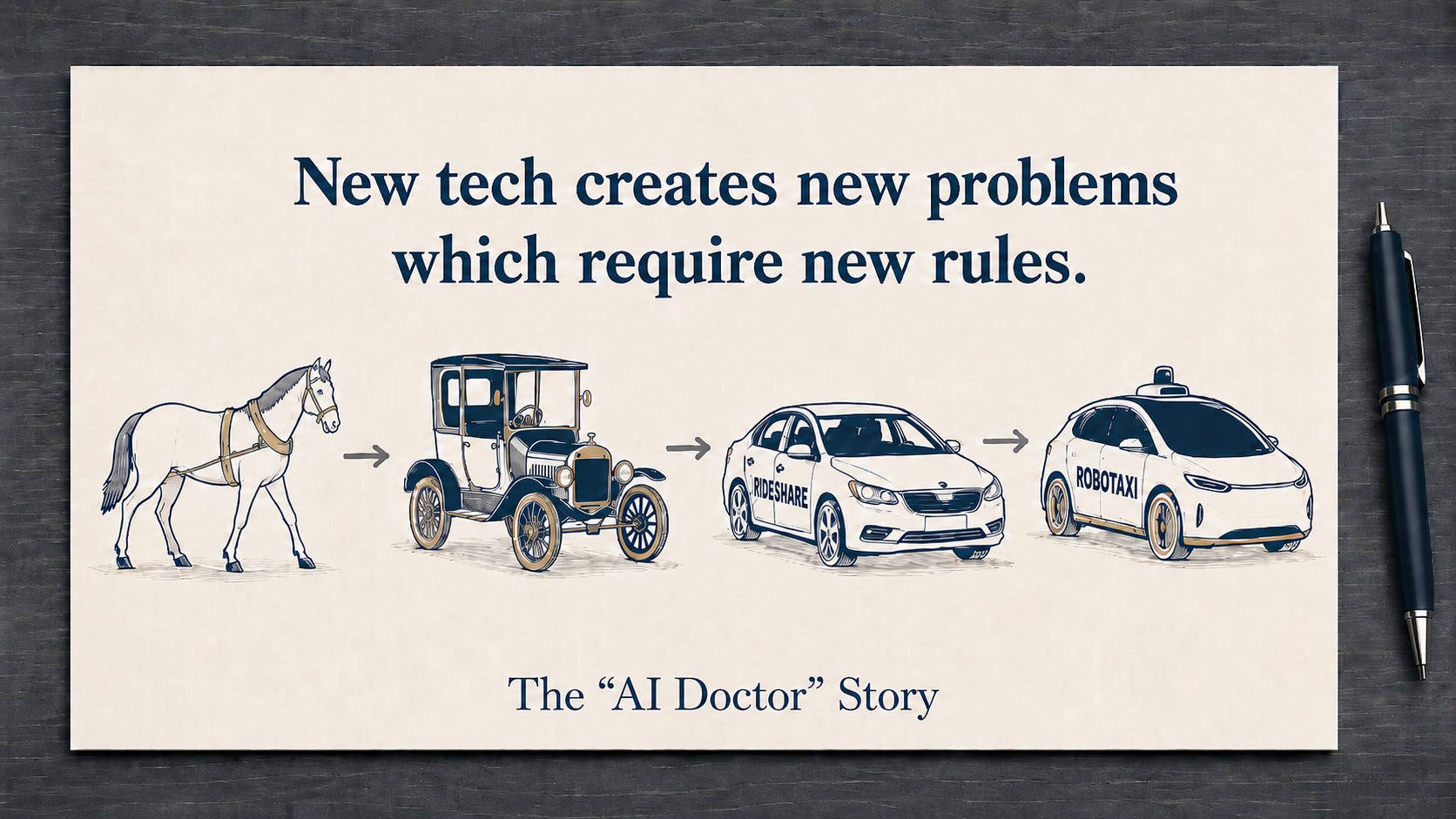
Part 1: When Cars Replaced Horses, the Rulebook Wasn’t Ready
Picture yourself on the sidewalk of a road in the 1900s. A new machine shows up on the road that does what horses used to do, except faster and without getting tired.
There’s just one problem: every rule on the books was written for horses.
Nobody knows who’s allowed to operate one of these machines. Or how fast they could go. Or on whose roads. Or who pays when one of them runs into somebody.
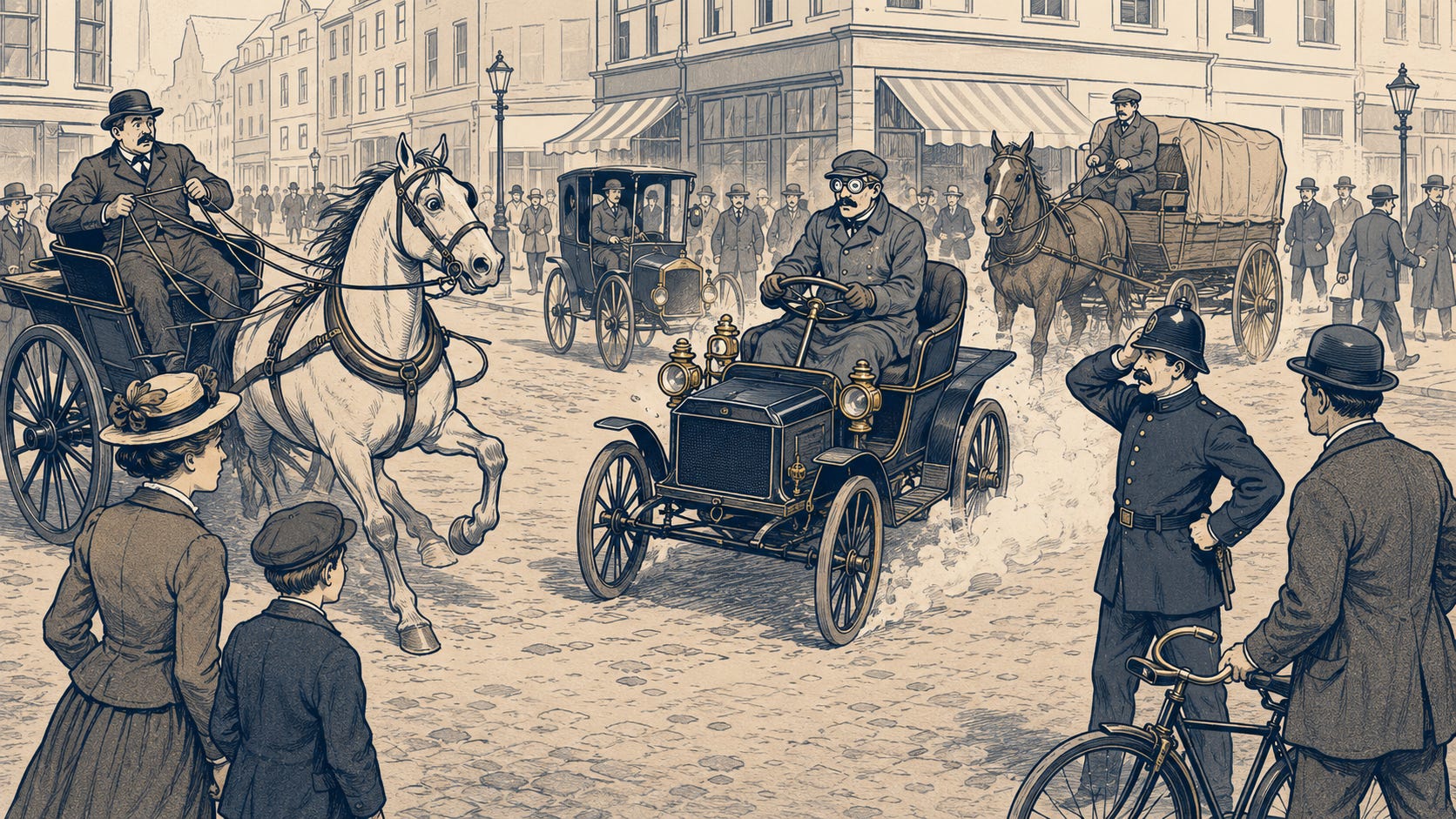
So society had to invent a rulebook that had never existed before.
These are things we take for granted today: driver’s licenses, traffic laws, speed limits, vehicle registration, insurance requirements, and more.
In short, a capable new technology arrived before the rulebook was ready. The people who wrote the new rules didn’t just regulate cars. They decided how cars would fit into society.
That is the first pattern: a new capability appears before the old legal categories know what to do with it.
Keep that pattern in mind, because we’re going to use it again.
Part 2: Uber Showed How Business Models Can Force New Rules
Fast-forward a century.
The law said that if you wanted to drive strangers around for money, you needed a taxi license. Uber’s drivers didn’t have one.
Was that legal?
Nobody knew.
It sat in a gray zone where it was not clearly allowed, but not clearly banned.
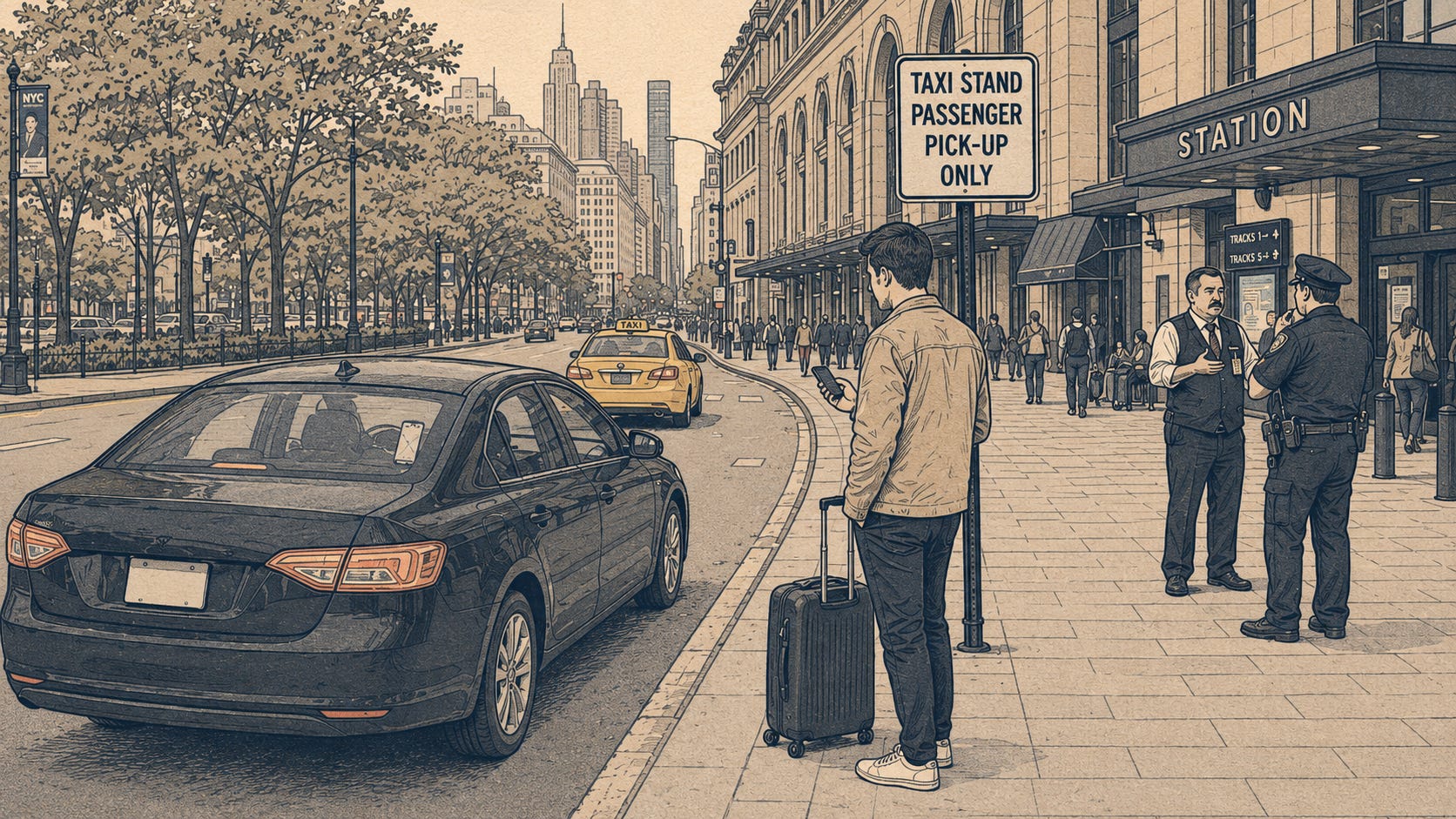
So the rule got rewritten. City by city, state by state, with different answers in different places.
Here’s the important part that most people miss: Uber didn’t win this in courtrooms first. It won by getting riders to love the service. It made people feel like the old way was the broken way. Then it used that public affection to pressure lawmakers into legalizing what the company was already doing.
The business model came first. The legal framework followed.
One more thing matters here: Uber and Lyft were fierce rivals, but they wanted the same category change. They disagreed over who should win the market. They agreed that the old taxi rules should not control the future.
On the other side, the taxi industry fought fiercely to keep the new thing out.
That is the second pattern: rivals can fight each other while still pushing for the same new rulebook.
Part 3: Robotaxis Ask Whether the Machine Can Be the Driver
The newest turn is more radical: the driver disappears.
Your ride is no longer a car driven by a person you hail through an app. Your ride is the machine itself.

Now the old questions return, and they’re even harder to answer:
Who is allowed to put a driverless car on the road?
In which states may it operate?
Who decides when it is safe enough?
When there’s a crash, who is responsible?
And most importantly, do we trust it?
That is the third pattern: once autonomy enters the picture, society has to decide whether the machine is merely a tool or the actor itself.
In other words, software can help the driver, but can it be the driver?
That question is being settled as we speak. Some fights are happening at the state level. Others are happening federally.
At this point, we’re ready to talk about medicine.
Now Apply the Robotaxi Fight to “AI Doctors”
Everything you just understood about cars is now happening in healthcare.
You only have to swap three things:
Swap the car for your body.
Swap driving for diagnosing and prescribing.
Swap the DMV for the medical board.
That is the basic mental model.
Bodies are not cars, and medicine is not transportation. But the governance pattern is remarkably similar.
A machine can now do something that, for over a century, only a licensed human was allowed to do: evaluate a patient, name a condition, and recommend a treatment.
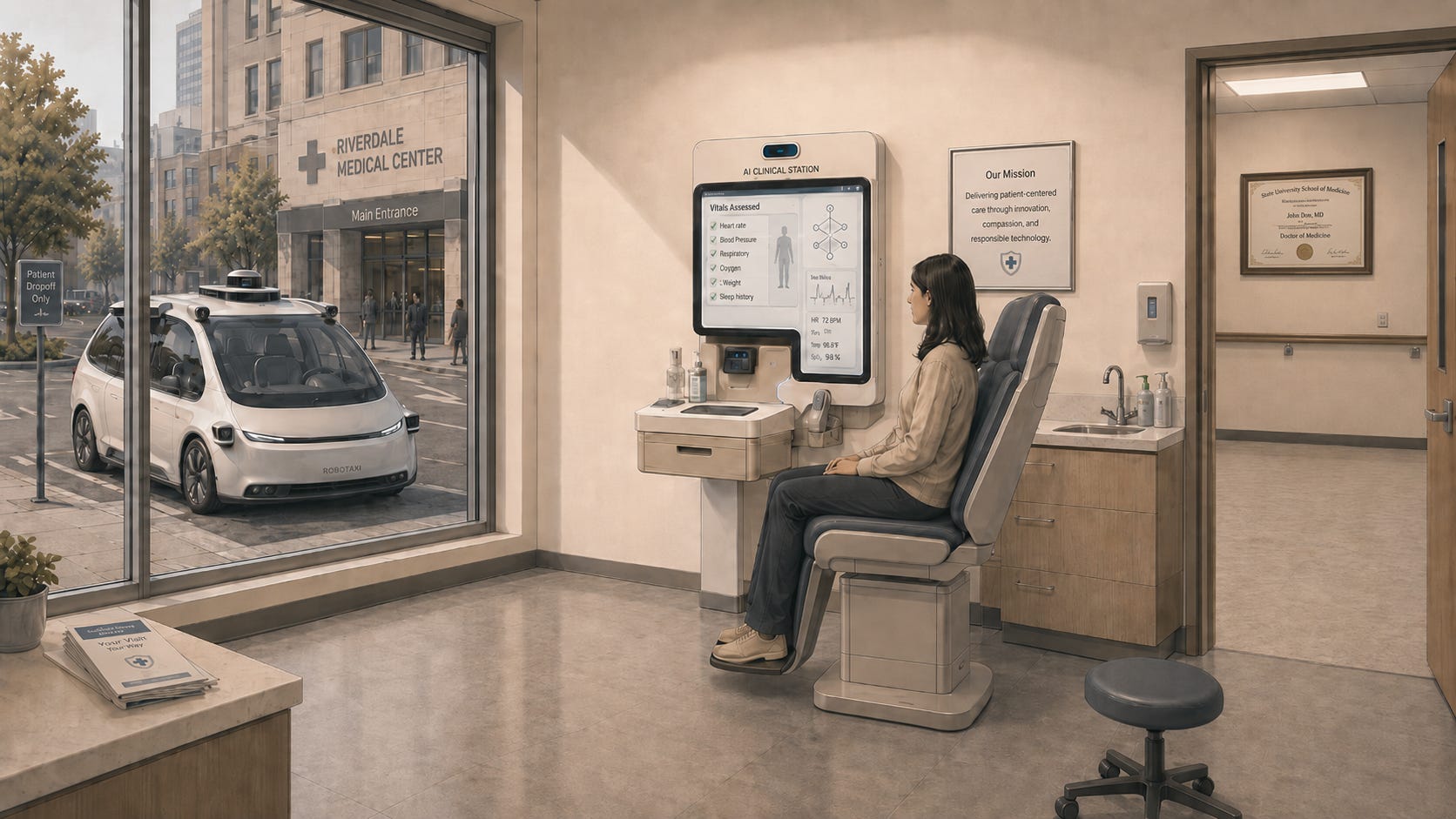
The old rules never imagined a non-human doing that work, so clinical AI is landing in a familiar gray zone: not clearly allowed, not clearly banned.
That gray zone is where the fight begins. Society must answer the question of whether AI can be the clinical actor itself rather than a tool for clinicians to use.
Can it diagnose?
Can it prescribe?
Can it manage care?
Can it do those things without a licensed human reviewing every decision?
And if it can, who gets to authorize that?
The FDA? A state medical board? A new AI-specific board? A regulatory sandbox? A private company? A physician standing somewhere in the background?
It sounds like policy language, and it is, but it’s also the future market structure of healthcare being negotiated.
The AI Doctor Rulebook Is Already Being Written
If this sounds like a far away future to you, I’d like to bring you to reality. Because the AI doctor fight is not merely hypothetical.
A think tank called the Cicero Institute has already published a model bill: the “AI Medical Services Act.”
The bill’s purpose is to create a licensing pathway for autonomous clinical AI, and versions of that idea are already appearing in statehouses.
That matters, because licensing is more than just completing paperwork.
Licensing defines what an actor is allowed to do. It defines who supervises whom. It defines who carries responsibility. It defines who can enter the market and who cannot.
In other words, the rulebook is the market map.
During my research, two companies stood out as useful examples in this land rush.
Doctronic appears to be taking the state-level route. In Utah, it entered a regulatory mitigation agreement that lets the company test its service without first going through the FDA approval pathway. It is currently in the first phase of its pilot there.
Certuma seems to be taking the opposite approach: pursue FDA approval first, then use that approval to scale nationally.
Like Uber and Lyft, they may be strategic rivals. But they both point toward the same destination: a healthcare system where autonomous software can perform work once reserved for licensed humans.
That is why the rule-writing matters.
The fight is not only about whether clinical AI works. It is about who gets licensed, who gets supervised, who carries liability, which pathway avoids regulatory friction, and which business model becomes legal to scale.
If one company can get a state to recognize autonomous clinical AI as a licensable actor, that creates one kind of future.
If another company can get FDA authorization and use it to pressure every other regulator, that creates another.
If medical boards insist that AI remains a tool used by accountable licensed clinicians, that creates a different future entirely.
The technology matters. But the incentive structures matter just as much.
The five-sentence version
Here is the whole pattern, distilled:
A new thing can suddenly do work that used to require a licensed human.
The old rules never imagined it, so it lands in a gray zone: not clearly allowed, not clearly banned.
The rules have to be rewritten.
Everyone who stands to gain races to write them their way.
Whoever shapes the rulebook shapes the market.
That is what happened with cars, then rideshare apps, then robotaxis.
And that is what’s beginning to happen with AI in medicine.
What to Watch as States Regulate AI Doctors
You don’t need a law degree or a medical degree to follow the AI doctor story.
You just need to watch the definitions.
When a state considers a bill defining what an “AI medical service” may do, pay attention.
When a proposal describes AI as a tool, a service, a provider, or something close to a licensee, pay attention.
When medical boards are placed in charge, pay attention.
When medical boards are bypassed, pay even closer attention.
When liability stays with a human clinician, moves to a company, or gets blurred, pay attention.
Because those details are not technicalities. They are the fight.
The country has not yet settled whether a machine can act like a doctor, who gets to authorize it, or who is accountable when something goes wrong.
Those decisions are being made now, in places most people are not watching.
Fortunately, you’re not “most people” anymore.
Read how I use AI in my writing here: AI Use Policy
Read how I use analytics to improve my newsletter here: Privacy & Analytics
The car analogy is the right one. This article nails it.
Here is the part that gets missed: the rulebook is not written after the technology proves itself.
It is written while the technology is still landing.
Whoever moves first, moves the definitions.
Doctronic goes state by state. Certuma goes through the FDA. Same destination. Different doors.
The quiet fight is not whether clinical AI works. It is whether it counts as a tool or an actor. That single word decides who carries liability, who supervises whom, and which business model becomes legal to scale.
Watch the definitions. That is the whole game.